
Attention: The Schmidt National Law Group is no longer accepting these cases.
December 2, 2025 — Infant botulism cases have recently triggered an urgent nationwide recall of ByHeart baby formula, prompting immediate action from health authorities. The U.S. Food and Drug Administration has pulled all unexpired lots from store shelves after multiple infants developed this rare but serious illness.
Consequently, the Centers for Disease Control and Prevention has confirmed 37 cases of infant botulism across 17 states, with all affected babies requiring hospitalization.
This developing situation has left parents scrambling for information about potential contamination risks, safety measures, and alternative feeding options. Importantly, health officials are conducting thorough investigations to determine exactly how Clostridium botulinum bacteria contaminated the formula products. This article provides critical information about the recall scope, symptoms parents should watch for, and official guidance for protecting vulnerable infants during this concerning outbreak.
FDA announces nationwide recall of ByHeart infant formula
On November 11, 2025, ByHeart Inc. issued a nationwide recall of all its infant formula products in cooperation with the U.S. Food and Drug Administration [1]. The announcement followed an ongoing FDA investigation into a multi-state outbreak of infant botulism linked to the company’s products.
All unexpired lots pulled from shelves
Initially, ByHeart recalled only two specific batches of their formula (batch codes 251261P2 and 251131P2, both with “Use by” dates of December 1, 2026) [2]. However, the company quickly expanded the recall to include all batches of ByHeart Whole Nutrition Infant Formula across all product lots [3]. This comprehensive action reflects the serious nature of the investigation after Clostridium botulinum was identified in some samples of the formula [3].
“The safety and well-being of every infant who uses our formula is, and always will be, our highest priority,” stated Mia Funt, ByHeart’s co-founder and president. “This nationwide recall reflects our commitment to protecting babies and giving families clear, actionable information” [1].
Recall includes cans and single-serve packets
The expanded recall specifically covers:
- All ByHeart Whole Nutrition Infant Formula 24-ounce cans (UPC: 5004496800)
- All ByHeart Whole Nutrition Infant Formula 0.60-ounce Anywhere Pack™ containing 14 packets per package (UPC: 5004496802) [3]
This action impacts all unexpired lots regardless of batch code or use-by date [1]. The FDA has emphasized that these products should not be used even if they appear normal, as contamination with C. botulinum might not be visible [3].
Additionally, the FDA has noted that ByHeart products constitute approximately 1% of all infant formula sold in the United States, therefore this recall is not expected to create shortage concerns for parents and caregivers [1].
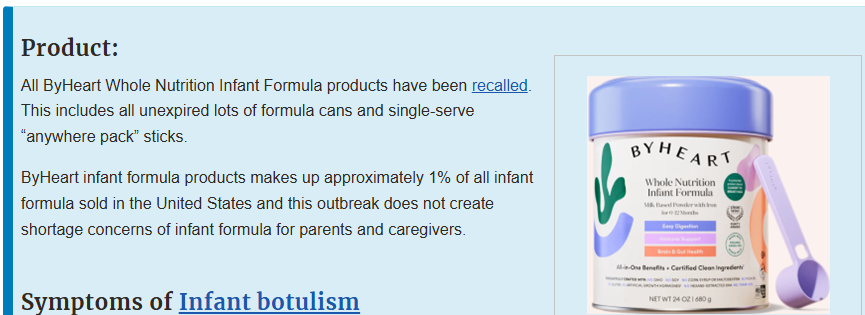
Retailers instructed to remove products immediately
Following the recall announcement, ByHeart notified all retail partners to immediately remove their formula products from store shelves [4]. The company reports having sent multiple notifications to retailers since November 9, with confirmation that communications reached stores [4]. Furthermore, the FDA has also issued separate notifications to retailers [4].
Nevertheless, federal authorities report concerning findings. Despite recall notifications, the FDA has received reports that recalled formula is still being found on store shelves across multiple states [1]. These products have been spotted at various major retailers including Walmart, Target, Kroger, Sprouts Organic Market, Safeway, Acme, Jewel-Osco, Shaw’s, Star Market, Smith’s, King Sooper’s, Albertson’s, Whole Foods, Wegman’s, and Publix locations [1].
According to ByHeart, “Based on Consumer Product Recall Best Practices, there are safeguards in place that are designed to ensure that purchases of ByHeart infant formula cannot be completed if product is still on shelves and is scanned at checkout systems” [4]. These point-of-sale safeguards serve as a final barrier to prevent consumers from purchasing recalled products.
Health departments across the country have joined the effort, with state agencies such as the Massachusetts Department of Public Health emphasizing that retailers must ensure all recalled ByHeart formula products are removed from shelves, returned products are removed from inventory and not resold, and staff are informed about the recall instructions [5].
Parents and caregivers who have purchased any ByHeart infant formula are advised to immediately stop using the product and follow specific FDA guidance for proper handling of potentially contaminated formula [6].
CDC confirms 37 infant botulism cases across 17 states
The Centers for Disease Control and Prevention has documented a rapidly expanding outbreak of infant botulism linked to ByHeart formula products. As of November 26, 2025, health officials have confirmed 37 cases of suspected or confirmed infant botulism across 17 states nationwide [1].
Timeline of illness onset from August to November
The first illness in this outbreak was detected on August 9, 2025, marking the beginning of a concerning trend that continued through mid-November [1]. Throughout the following weeks, public health agencies noted a steady increase in reported cases. Subsequently, by November 8, officials had identified 13 infants with suspected or confirmed infant botulism across 10 states [7]. The situation escalated rapidly as more cases were discovered. By November 14, the count had risen to 23 cases in 13 states, followed by 31 cases in 15 states by November 19 [7]. Ultimately, the case count reached 37 by November 26, with Massachusetts and Wisconsin joining the list of affected states [7].
For 36 of these cases where onset information was available, illnesses began between August 9 and November 19, 2025 [1]. Notably, the six most recent cases were reported in the week leading up to November 26, indicating the outbreak had not yet been contained [7].
All affected infants hospitalized, no deaths reported
Every one of the 37 infants identified in this outbreak required hospitalization [1]. All received treatment with BabyBIG®, an antitoxin medication specifically designed to neutralize botulinum toxin [7]. Presently, no deaths have been reported in connection with this outbreak [1].
For 35 of the cases where demographic information was available, the affected infants ranged in age from 16 to 264 days (approximately 2 weeks to 9 months) [1]. Fifteen of these infants (43%) were female [1]. The California Department of Public Health noted that infants typically began showing symptoms within 3 to 30 days after consuming the contaminated formula [4].
Medical authorities point out that infant botulism begins with constipation, plus feeding difficulties and progresses to more severe symptoms if left untreated [4]. Without prompt intervention, the condition can lead to flaccid paralysis and respiratory problems requiring extended hospitalization [4].
States with highest case counts
The outbreak has affected infants in states throughout the country. The distribution of cases reveals certain geographic patterns, with Texas and California experiencing the highest number of illnesses:
- Texas: 8 cases
- California: 5 cases
- Arizona: 3 cases
- Oregon: 3 cases
- Illinois: 2 cases
- Massachusetts: 2 cases
- Minnesota: 2 cases
- North Carolina: 2 cases
- Washington: 2 cases [3]
The remaining states each reported a single case: Idaho, Kentucky, Maine, Michigan, New Jersey, Pennsylvania, Rhode Island, and Wisconsin [3]. In particular, in Washington state, health officials identified the affected infant as a resident of Lewis County [8].
The geographic spread of this outbreak is exceptionally wide, encompassing regions across the entire United States. Health departments in multiple states are working in coordination with federal agencies to identify additional cases and prevent further exposures as investigations continue [5].
What symptoms should parents watch for?
Parents whose infants may have consumed ByHeart formula need to recognize potential infant botulism symptoms, which can emerge anywhere from 3 to 30 days after exposure to the bacteria [9]. The condition typically develops gradually, making early recognition crucial for prompt medical intervention.
Early signs: constipation, poor feeding, weak cry
Constipation is often the earliest sign of infant botulism, appearing before other symptoms [10]. This early warning sign might seem common and benign, yet when combined with other symptoms, it becomes a significant indicator [11].
Beyond constipation, parents should watch for:
- Poor feeding: Babies may show a weak suck, tire easily during feedings, or consume less formula than usual [12]
- Altered or weak cry: The infant’s cry may sound different or weaker than normal [6]
- Decreased facial expressions: The baby’s face may appear less expressive or have a “flat” look [13]
- Poor head control: An inability to lift or control head movement [6]
Unlike many other infant illnesses, babies with infant botulism typically remain alert and do not develop a fever [12]. Thus, seemingly subtle changes in an infant’s behavior or physical abilities warrant careful attention.
Progression to respiratory distress and paralysis
As the condition worsens, the neurotoxin causes descending, bilateral, and symmetric paralysis [14]. This progressive weakening affects muscles throughout the body, starting from the face and moving downward.
The progression of symptoms typically follows this pattern:
- Facial weakness: Drooping eyelids and reduced facial expressions [11]
- Feeding difficulties: Choking when trying to feed, excessive drooling, and difficulty swallowing [12]
- Limb weakness: “Floppy” movements, particularly in the arms and legs [12]
- Reduced reflexes: Diminished response to stimuli, including pupils that respond slowly to light [11]
Medical experts note that the combination of growing muscle weakness, constipation, and slow-responding pupils is particularly telling, as few other conditions produce this specific symptom pattern [11]. Without treatment, the paralysis can eventually affect the respiratory muscles, leading to breathing difficulties that require hospitalization [4].
When to seek emergency care
Infant botulism constitutes a medical emergency requiring immediate attention. Parents should seek immediate medical care if their baby has consumed ByHeart formula in the past 30 days and exhibits any symptoms of the condition [6].
Emergency medical attention is necessary if parents notice:
- Any signs of difficulty breathing or respiratory distress [11]
- Progressive muscle weakness [11]
- Poor feeding, especially with difficulty swallowing [6]
- Loss of head control or decreased facial expressions [13]
Dr. Ramos-Platt, a medical expert on infant botulism, emphasizes that since the condition is rare, it can be challenging to diagnose [11]. Although symptoms develop more gradually than in adults, rapid diagnosis and treatment remain vital as respiratory failure can occur suddenly [14].
Parents should monitor their infant for a full 30 days after the last consumption of ByHeart formula [6]. When in doubt, it is always better to err on the side of caution and seek immediate medical attention, either by contacting the child’s pediatrician during office hours or going directly to the nearest emergency room or pediatric specialty Emergency Department [11].
FDA and CDC investigate contamination source
Federal investigators have uncovered alarming evidence as they probe the source of the nationwide infant botulism outbreak tied to ByHeart formula. Joint efforts between the Food and Drug Administration (FDA) and Centers for Disease Control and Prevention (CDC) have identified serious contamination issues and manufacturing concerns at multiple stages of production.
Clostridium botulinum found in unopened formula
Laboratory testing confirmed the presence of Clostridium botulinum in unopened containers of ByHeart formula, providing concrete evidence of pre-consumption contamination. Testing conducted by an independent laboratory working with ByHeart identified the deadly bacteria in multiple samples [15]. Moreover, the California Department of Public Health validated these findings by confirming the presence of Clostridium botulinum type A in cultures from an opened can of formula that had been fed to a sick infant [5].
Testing of 36 samples from three different lots revealed five samples containing the bacteria capable of producing the potentially fatal illness [16]. Based on these results, ByHeart acknowledged they “cannot rule out the risk that all ByHeart formula across all product lots may have been contaminated” [16]. Officials noted that Clostridium botulinum can be unevenly distributed throughout powdered formula, making detection challenging [16].
Facility inspections reveal GMP violations
FDA inspections at ByHeart production facilities uncovered numerous good manufacturing practice (GMP) violations dating back to 2022 [2]. Records released by the FDA on November 26 showed that unsanitary conditions at the company’s production plants have persisted for years [2]. Among the critical issues documented at the Allerton, Iowa facility were:
- Positive tests for Cronobacter in production areas [2]
- Significant pest activity and rodent infestations [2]
- Leaking roofs and cracked equipment [2]
- Failure to maintain proper sanitation controls [2]
An inspection in February 2025 prompted seven discussions between FDA investigators and ByHeart management regarding these violations [2]. The facility was classified as “Voluntary Action Indicated” (VAI), citing ongoing GMP deficiencies [1].
Ongoing lab testing and sample analysis
As investigations continued, multiple agencies undertook additional testing to determine the exact contamination source. The FDA emphasized that detecting Clostridium botulinum in infant formula presents unique challenges, as “a negative test result does not rule out the presence of the bacteria in the product” [1].
Currently, comprehensive laboratory analysis is underway at federal, state, and independent facilities. Beyond standard testing, whole genome sequencing (WGS) is being conducted to identify specific bacterial strains and potential connections between environmental samples and illness cases [17]. Authorities expect additional test results “in the coming weeks” that may further clarify the contamination pathway [1].
Public health officials issue urgent guidance
In response to the escalating infant botulism outbreak, public health agencies have released urgent guidance for all stakeholders involved in the ByHeart formula recall.
Instructions for parents and caregivers
Parents must immediately discontinue using all ByHeart formula products, regardless of lot numbers or purchase date. After stopping use, caregivers should:
- Take photos of package information and lot numbers
- Label containers “DO NOT USE” and store them safely for possible testing [18]
- Monitor infants for symptoms for a full 30 days after last consumption [19]
- Thoroughly clean all items that contacted the formula with hot, soapy water followed by disinfection [20]
For infants showing any symptoms, parents should seek emergency medical care immediately rather than waiting. The California Department of Public Health has established a dedicated hotline (1-833-398-2022) operating daily from 7 a.m. to 11 p.m. PST for concerned families [4].
Retailer responsibilities and compliance
Retailers across all channels must verify complete removal of ByHeart products from their inventory. Health departments emphasize that stores should:
- Remove all recalled products from shelves immediately
- Properly handle returned products without reselling
- Ensure staff awareness of recall procedures [21]
Despite these requirements, FDA inspectors have found recalled formula still available at multiple major retailers [22]. Alongside physical removal, many stores have implemented electronic point-of-sale blocks to prevent scanning of recalled products [22].
Clinician protocols and reporting requirements
Healthcare providers have received specialized guidance for handling potential infant botulism cases. Medical professionals should:
- Report all suspected cases immediately to state health departments
- Consult with the Infant Botulism Treatment and Prevention Program at 510-231-7600 (available 24/7) [4]
- Begin treatment promptly without waiting for laboratory confirmation [4]
Given the time-sensitive nature of treatment, clinicians are instructed to administer BabyBIG® antitoxin as early as possible upon clinical suspicion of infant botulism [21].
The nationwide ByHeart formula recall represents a significant public health emergency affecting vulnerable infants across the country.
Consequently, the 37 confirmed cases spanning 17 states underscore the serious nature of this outbreak, particularly since every affected infant required hospitalization and treatment with BabyBIG® antitoxin. Laboratory findings have undoubtedly confirmed the presence of Clostridium botulinum in unopened formula containers, establishing a direct link between the product and the illness.
Parents and caregivers must remain vigilant for early warning signs such as constipation, poor feeding, weak cries, and decreased facial expressions. These seemingly mild symptoms can rapidly progress to respiratory distress and paralysis if left untreated. Therefore, immediate medical attention becomes essential for any infant showing these symptoms, especially those who consumed ByHeart formula within the past 30 days.
Federal investigations continue as officials examine manufacturing deficiencies at ByHeart facilities, where inspectors discovered concerning GMP violations including pest activity and inadequate sanitation controls. Meanwhile, retailers across the country bear responsibility for removing all recalled products from their shelves, though compliance issues persist with recalled formula still found at major stores nationwide.
The comprehensive nature of this recall – covering all unexpired lots regardless of batch code or use-by date – reflects the gravity of the situation. Nevertheless, health authorities note that ByHeart products constitute approximately 1% of all infant formula sold in the United States, thus widespread shortages remain unlikely.
Above all, this outbreak serves as a critical reminder about food safety vulnerabilities for our youngest population. Families affected by this recall should follow official guidance: discontinue using all ByHeart products immediately, monitor infants closely, and seek prompt medical care if symptoms appear. As investigations progress, regulatory oversight of infant formula production will likely face increased scrutiny to prevent similar outbreaks in the future.
References
[1] – https://www.fda.gov/food/outbreaks-foodborne-illness/outbreak-investigation-infant-botulism-infant-formula-november-2025
[2] – https://www.foodsafetynews.com/2025/11/fda-releases-records-that-show-problems-at-byheart-date-back-years/
[3] – https://www.marlerblog.com/case-news/byheart-infant-botulism-cases-jump-to-37-in-17-states-international-warnings/
[4] – https://www.cdc.gov/botulism/outbreaks-investigations/infant-formula-nov-2025/index.html
[5] – https://www.cdph.ca.gov/Programs/OPA/Pages/NR25-017.aspx
[6] – https://www.infantbotulism.org/
[7] – https://www.cdc.gov/botulism/outbreaks-investigations/infant-formula-nov-2025/investigation.html
[8] – https://doh.wa.gov/you-and-your-family/illness-and-disease-z/foodborne-illness/outbreaks/2025-infant-botulism-outbreak-linked-infant-formula
[9] – https://dph.illinois.gov/topics-services/diseases-and-conditions/diseases-a-z-list/diseases/infant-botulism.html
[10] – https://health.stonybrookmedicine.edu/infant-botulism-signs-and-symptoms-you-shouldnt-ignore/
[11] – https://www.chla.org/blog/advice-experts/what-know-about-infant-botulism
[12] – https://my.clevelandclinic.org/health/diseases/infant-botulism
[13] – https://www.health.state.mn.us/news/pressrel/2025/botulism111025.html
[14] – https://www.ncbi.nlm.nih.gov/books/NBK493178/
[15] – https://publications.aap.org/aapnews/news/33819/Samples-of-recalled-baby-formula-test-positive-for?searchresult=1
[16] – https://www.pbs.org/newshour/health/all-lots-of-byheart-baby-formula-may-be-contaminated-with-botulism-bacteria-tests-show
[17] – https://www.fda.gov/inspections-compliance-enforcement-and-criminal-investigations/warning-letters/byheart-inc-653854-08302023
[18] – https://byheart.com/pages/an-update-from-our-founders-on-our-voluntary-recall-november-2025?srsltid=AfmBOorKskXR5avIjbNRPYdcchMRR0GEo54LUWg4AMu8dehZfWL4396c
[19] – https://newsletter.pedsdoctalk.com/p/byheart-infant-formula-recall-your-questions-answers-next-steps
[20] – https://byheart.com/pages/an-update-from-our-founders-on-our-voluntary-recall-november-2025?srsltid=AfmBOoqu4lKnUzyYQSxpaQPTdOj1b1C1DJPjPyWWAQe0yUeevPIXMQ6E
[21] – https://www.mass.gov/news/dph-issues-public-health-advisory-on-recalled-byheart-infant-formula-products
[22] – https://www.healthbeat.org/2025/11/22/byheart-baby-formula-recall-fda-delays/